Geothermal Development on Federal Lands
Written by Amardeep Dhanju
March 24, 2026
Geothermal energy on federal lands is governed by the Geothermal Steam Act (GSA) of 1970, which authorizes the U.S. Department of Interior (DOI) to lease public lands for geothermal exploration and development. Following its enactment, the DOI established an interdisciplinary geothermal task force to develop a regulatory framework for resource development. Subsequently, the Secretary of Interior delegated regulatory authority to the Bureau of Land Management (BLM). Concurrently, the United States Geological Survey (USGS) was designated to serve as the primary scientific authority, responsible for assessing, mapping, and evaluating geothermal resources on federal lands. Approximately 245 million acres of federal land are potentially available for geothermal leasing, including over 100 million acres managed by the U.S. Forest Service.
GSA Leasing and Regulatory Framework
BLM administers geothermal resources through a multi-phase regulatory framework, with regulations codified at 43 CFR Part 3200, and operational requirements addressed in Part 3280. Project development proceeds through sequential phases: leasing, exploration, drilling and wellfield development, production, and reclamation.
Each phase may trigger a review under the National Environmental Policy Act (NEPA), and a single project can require multiple NEPA analyses over the course of project development. For example, as illustrated in Figure 1, depending on the scope and intensity of potential environmental impacts, BLM may apply a NEPA Categorical Exclusion (CX), prepare an Environmental Assessment (EA), or, for actions with significant impacts, complete an Environmental Impact Statement (EIS) across various phases of project development.
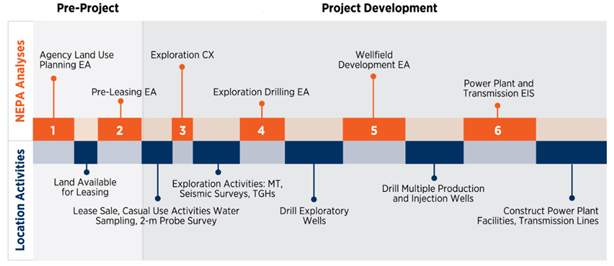
Figure 1. Geothermal project permitting on federal lands. Figure note: EA = Environmental Assessment, EIS: Environmental Impact Statement, CX: Categorical Exclusion. (source: energy.gov)
The Geothermal Steam Act requires competitive leasing for commercial electricity generation on federal lands. This is typically held online via EnergyNet, an online bidding marketplace and transaction platform. Usually, multiple parcels are offered during each auction. The regulations also provide limited pathways for non-competitive leasing, such as where mining claims with approved plan of operations exist, or for co-production opportunities using existing oil and gas wells.
To accelerate the development of geothermal resources, the Energy Policy Act of 2005 (EPAct 2005) mandated BLM to conduct competitive lease sales for geothermal energy at least every two years in states with pending nominations. BLM geothermal nominations are made when written requests from industry or the public ask the BLM to include specific public lands in competitive geothermal lease sale. While nominations are a common framework for leasing, BLM can also lease federal lands where no nominations have been made.
On December 16, 2025, the BLM moved towards a more aggressive leasing schedule with the issuance of Instruction Memorandum IM 2026-004. This guidance requires annual competitive lease sales and directs BLM State Offices to adopt more standardized and frequent leasing cycles. Geothermal lease areas are identified through the BLM’s land-use planning process based on resource potential, typically within Known Geothermal Resource Areas (KGRAs) and are further informed by the Programmatic Environmental Impact Statement (PEIS), which identifies public lands suitable for leasing.
BLM Lease Terms and Conditions
Geothermal leases issued by the BLM have a primary term of 10 years and may be extended for up to two additional five-year periods. Lessees are required to pay annual rent on a per-acre basis and production royalties based on gross proceeds. Revenues from geothermal leases are distributed with 50 percent allocated to the state, 25 percent to the host county, and remaining 25 percent deposited in the U.S. Treasury.
Geothermal Development Nationwide
Since the first competitive lease sale in California in 1974, BLM has issued leases across 11 western states: Arizona, California, Colorado, Idaho, Montana, Nevada, New Mexico, Oregon, Utah, Washington and Wyoming. Currently, 51 geothermal power plants operate on BLM-managed lands, representing approximately 2.6 GW of installed capacity. These projects are concentrated in California, Idaho, Nevada, New Mexico, Oregon and Utah. In addition, 14 geothermal projects totaling 2.4 GW have been approved since May 2021 across California, Nevada, and Utah.
To support continued industry growth, BLM has proposed multiple statewide lease sales for 2026 and 2027, including two lease sales in Idaho (November 2026 and November 2027), one sale in Nevada on October 20, 2026, a lease sale in New Mexico in April 2026, and a sale in Utah on August 18, 2026. These lease sales are expected to provide sufficient acreage to support continued expansion of the geothermal industry on federal lands.
Geothermal Development California
California remains the national leader in geothermal energy, housing approximately 2.8 GW of installed capacity across 28 active projects, representing roughly 70% of total capacity nationwide. BLM has held three lease sales in the state since 2014. The August 2025 auction was the most successful in recent history, with bids submitted on all 13 parcels offered during the sale, totaling more than 22,000 acres across Imperial, Lassen and Modoc counties. While additional lease sales have not been announced yet, BLM may offer future leases in California pending industry or public nominations. In the interim, sufficient leased acreage remains available to support continued resource development.
Tax Incentives and DOE Funding
The Energy Improvement and Extension Act of 2008 formally extended the Investment Tax Credit (ITC) and the Production Tax Credit (PTC) to include geothermal energy. In 2025, the One Big Beautiful Bill Act (OBBBA) signed by President Trump, preserved these incentives through 2035, provided construction begins by the end of 2033.
The U.S. Department of Energy (DOE) continues to drive innovation in the sector. In February 2026, DOE announced a $171.5 million funding opportunity – the largest single tranche of investment in the industry to date – to support field-scale tests for enhanced geothermal systems. This follows substantial support to the sector from the 2021 Infrastructure Investment and Jobs Act (IIJA), which provided $24 million for Fervo Energy’s Cape Station project located on BLM lands in Beaver County, Utah.
Conclusion
The landscape for geothermal energy development on federal lands is evolving rapidly, driven by more frequent leasing, continued financial incentives, and efforts to streamline regulatory processes. The transition to annual competitive lease sales, coupled with the extension of key tax incentives through 2035, has provided greater certainty for sustained resource development.
The geothermal sector is one of few renewable resources that continues to receive bipartisan support in Congress. The industry is actively advancing technologies such as Enhanced Geothermal Systems (EGS; see previous Aspen Blog Posts) and supercritical geothermal systems to deliver reliable baseload power. To support this potential, BLM is working to advance the development of existing federal leases in a timely and responsive manner.