

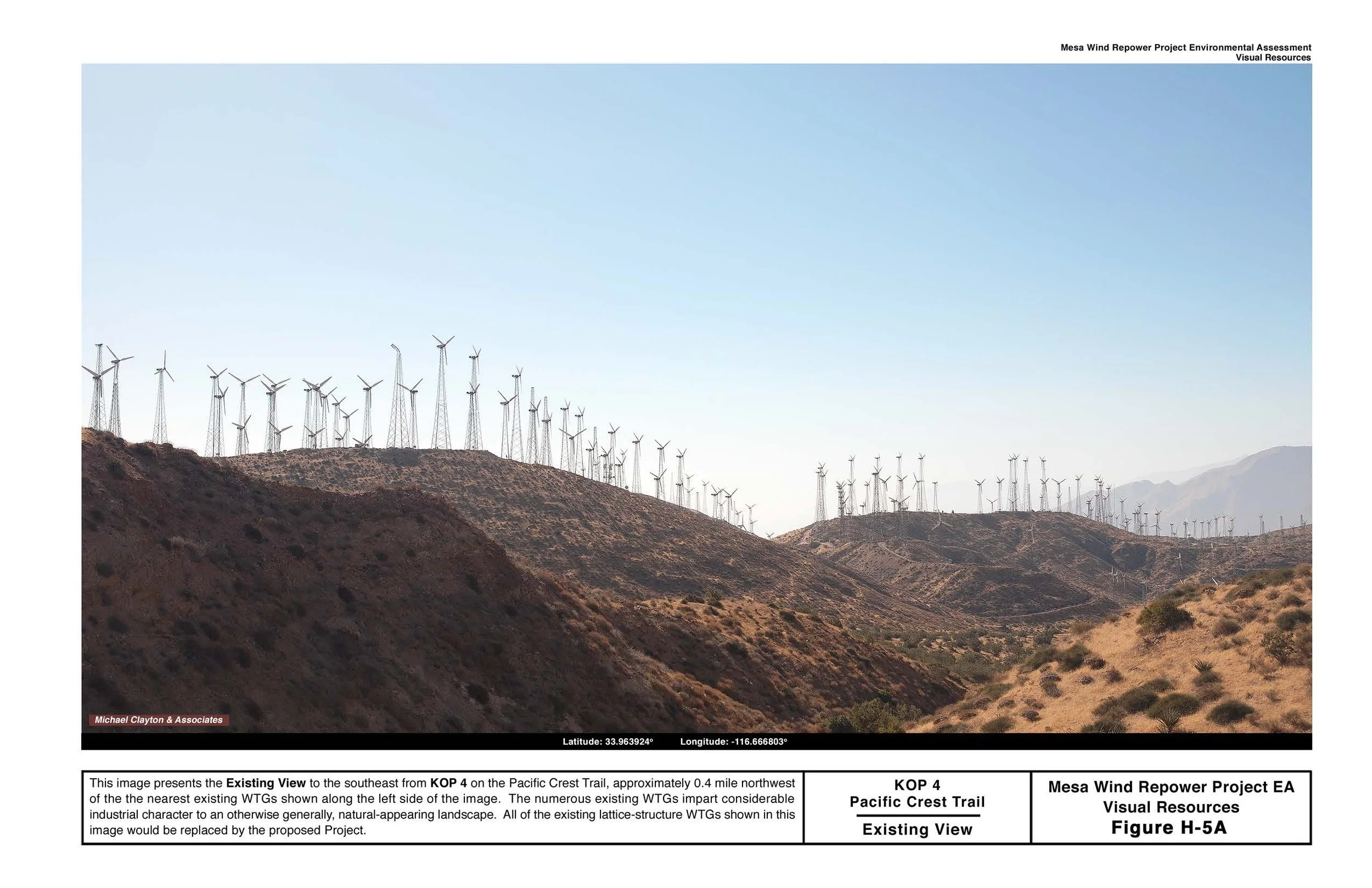
Before Repowering
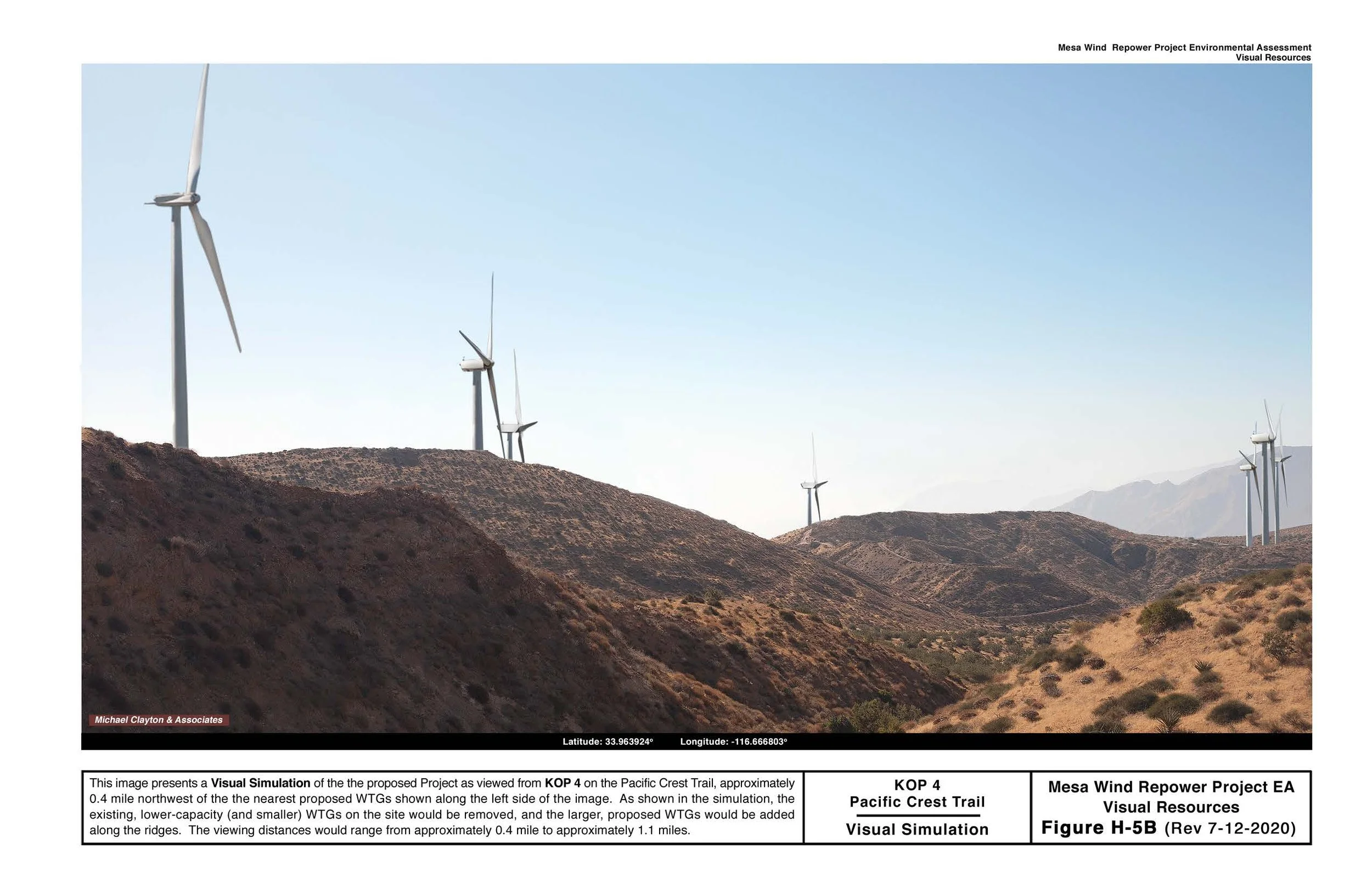
After Repowering
Wind is an Essential Component of California’s Renewable Energy Portfolio
In 2018, California enacted Senate Bill (SB) 100 to accelerate the transition to renewable energy and address the effects of climate change. SB 100 set a goal of having renewable energy and zero-carbon resources supply 100% of retail electricity sales by 2045.[1]
Brief history of the wind power development in California:
Construction of wind generation projects in California began in the 1980s. Development was initially focused in the Altamont Pass (eastern Alameda County), the Tehachapi area (Kern County, west of the town of Mojave), and the San Gorgonio Pass (north of Palm Springs in Riverside County). As of 2024, California has approximately 6,000 megawatts (MW) of installed onshore wind energy,[2] and wind accounted for approximately 7% of our in-state electricity generation.
The majority of California’s wind generation now occurs in six regions:[3]
Tehachapi: 3,254 MW
Southern Solano County: 1,096 MW
San Gorgonio Pass: 667 MW
Altamont Pass: 327 MW
Eastern San Diego County: 183 MW
Pacheco (Merced County): 148 MW
To meet SB 100 goals, the California Independent System Operator (CAISO) estimated in 2026 that California would require 18,000 MW of onshore wind energy, generated both in-state and imported from out-of-state (Arizona, Idaho, New Mexico, and Wyoming). The in-state generation was expected by the CAISO to be approximately 8,000 MW, a 33% increase from the current wind generation of about 6,000 MW.[4] Clearly, to help meet SB 100 goals, it is important for California to maintain or increase our in-state wind generation capacity.
In a 2026 Stanford University study,[5] researchers estimated that replacing (or “repowering”) California’s older wind turbines could increase California’s annual onshore wind generation by up to 24%.
On a national level, approximately 40,000 MW of wind projects will reach the 20-year operational milestone by 2030.[6] Repowering existing wind developments by installing newer, larger turbines could allow the U.S. to double its current onshore wind capacity, without requiring additional land.[7] The U.S. now has 153,000 MW of installed capacity. These existing wind turbines range in capacity from less than 0.1 MW to 6 MW per turbine.[8] Replacement of existing, low-capacity turbines with newer turbines that could each generate a minimum of 3.5 MW would allow increased renewable generation.
Repower Requirements
The repower process requires a substantial demolition and recycling effort (due to the removal of many small turbines) as well as construction efforts to allow transport and installation of new large turbines; however, no new land is generally required for the larger turbines. The installation process often requires widening of access roads and development of large laydown areas to accommodate the size of the newer turbine blades, nacelles, and foundation components. However, the environmental benefits of repowering are substantial. In addition to making available large land areas that were previously occupied by small turbines, there are aesthetic benefits due to the dramatic reduction in the number of turbines.
Aspen’s Support of Repower Projects
Aspen Environmental Group has been supporting the environmental assessment and permitting of wind repower projects on federal and private lands in Riverside County for more than 10 years. Construction of two major repower efforts was recently completed after a complex local, state, and federal permitting process:
The Mesa Wind Project Repower is located on 401 acres of Bureau of Land Management (BLM)-administered lands in Riverside County, 11 miles northwest of the City of Palm Springs. The wind project was originally built in 1983–1984 and consisted of 460 65-kilowatt turbines that generated 30 MW of electricity. The repowering of the Mesa Wind Project resulted in the removal of the 460 turbines and installation of 8 new turbines (each with a 3.75 MW capacity), resulting in a total power generation of 30 MW, equal to the original output of the 460 turbines.
The Alta Mesa Wind Project is located on 640 acres in Riverside County, adjacent to the Mesa Wind Project. Alta Mesa was built in three phases between 1987 and 1998 and consisted of 159 170-kilowatt turbines that generated 27 MW of electricity. The repowering of the Alta Mesa Wind Project resulted in the removal of 159 turbines and construction of 7 new 3.75 MW capacity turbines, with a total power production of almost 27 MW, equal to the original output of the 159 turbines.
The photos show the “before and after” of a portion of these projects; the aesthetic benefit is clear.
Aspen’s work on the Mesa and Alta Mesa wind repower projects included completion of biological, cultural, and paleontological surveys, preparation of BLM and County applications, preparation of a California Environmental Quality Act (CEQA) Initial Study and Mitigated Negative Declaration, and obtaining permits from the California Department of Fish & Wildlife (Incidental Take Permit and Lakebed and Stream Alteration Agreement) and Regional Water Quality Control Board (Waste Discharge Requirements).
Aspen’s work on the Mesa Project also included preparation of a National Environmental Policy Act (NEPA) Environmental Assessment for the BLM. For the Alta Mesa Project, Aspen coordinated with the Coachella Valley Conservation Commission regarding compliance with the Coachella Valley Multi-Species Habitat Conservation Plan. Additionally, Aspen conducted preconstruction compliance and construction monitoring during the removal of the old turbines and installation of the new ones for both projects. Currently, Aspen is overseeing restoration efforts, and we recently prepared the CDFW Routine Maintenance Agreement applications for each project for operations and maintenance.
These projects demonstrate Aspen’s ability to navigate complex permitting and construction processes at the forefront of renewable energy development as it relates to onshore wind turbine replacement. Reach out to Aspen’s wind repower Project Manager, Vida Strong (VStrong@aspeneg.com) with questions about the repower process.
[1] Ibid. 2018. SB 100 Joint Agency Report. https://www.energy.ca.gov/sb100.
[2] CEC (California Energy Commission). 2024 Total System Electric Generation. https://www.energy.ca.gov/data-reports/energy-almanac/california-electricity-data/2024-total-system-electric-generation.
[3] CalWEA (California Wind Energy Association). 2026. Fast Facts about California Wind Energy. https://www.calwea.org/fast-facts.
[4] CAISO (California Independent System Operator). 2025-2026 Transmission Plan. https://www.caiso.com/documents/board-approved-2025-2026-transmission-plan.pdf.
[5] Mühlbauer, A., Fan, Y. F., Sambor, D. J., & Jacobson, M. Z. 2026. The potential for onshore wind repowering to hasten the energy transition in the United States. Proceedings of the National Academy of Sciences, 123(12). https://doi.org/10.1073/pnas.2521050123.
[6] Largue, Pamela. 2026. Why repowering wind is key to meeting the AI power surge. https://www.enlit.world/library/why-repowering-wind-is-key-to-meeting-the-ai-power-surge.
[7] Mühlbauer, A., Fan, Y. F., Sambor, D. J., & Jacobson, M. Z. (2026). The potential for onshore wind repowering to hasten the energy transition in the United States. Proceedings of the National Academy of Sciences, 123(12). https://doi.org/10.1073/pnas.2521050123.
[8] Hoen, B et al. 2026. U.S. Wind Turbine Database files (USWTDB V8.3). Lawrence Berkeley National Laboratory. https://eta-publications.lbl.gov/publications/us-wind-turbine-database-files#:~:text=The%20latest%20release%20includes%20data%20on%2075%2C727%20turbines,a%20few%20from%20the%20third%20quarter%20of%202025.
